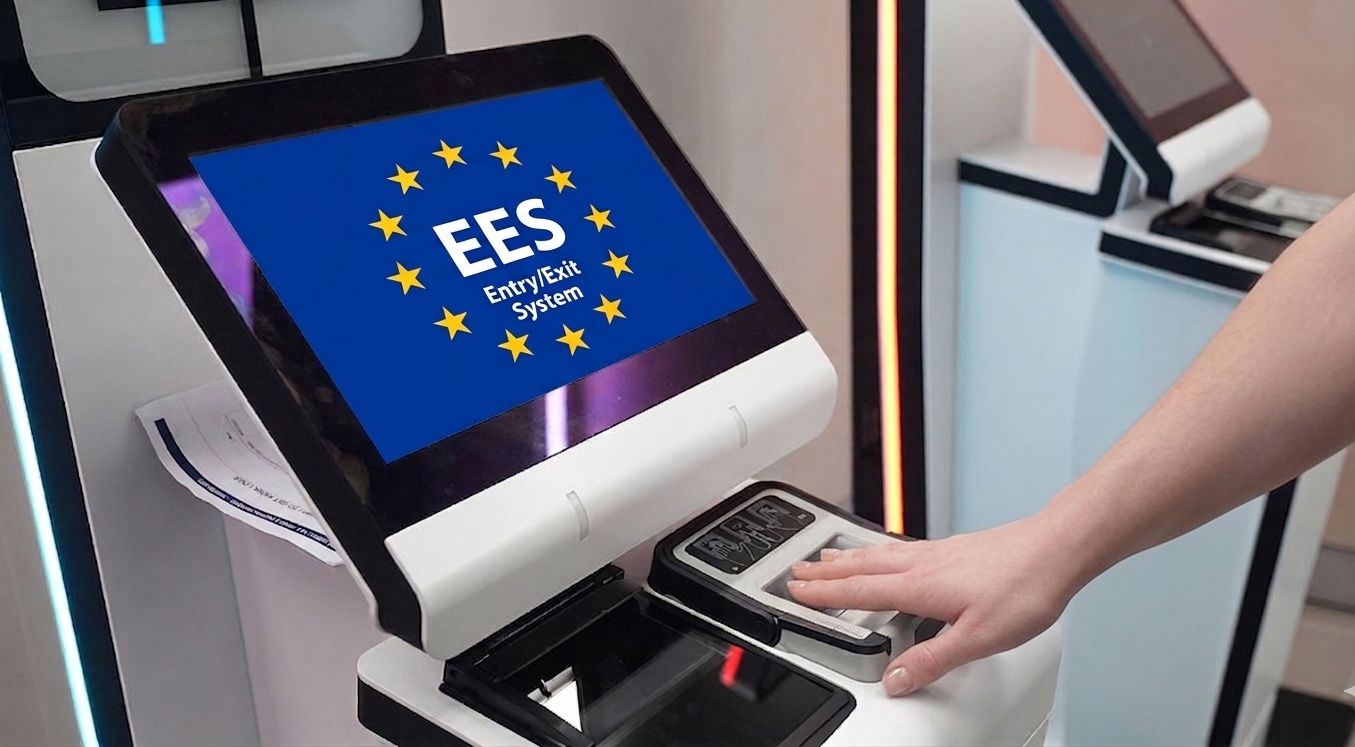
Starting from April 10, 2026, automated border control has been fully implemented in Europe with the launch of the EU Entry/Exit System (EES). It applies to all citizens of countries outside the European Union and the Schengen Area, including Ukrainians.
Biometric border control has replaced the привычне manual passport stamping, meaning that border crossings are now recorded digitally across the borders of 29 Schengen countries. The EES automatically registers the date, time, and place of each entry and exit, and also stores biometric data such as fingerprints and a facial image.
The main goal of the new EU border crossing rules is to enhance security at the EU’s external borders and improve control over the permitted length of stay. The biometric system automatically tracks whether a traveler exceeds the allowed 90 days within a 180-day period.
What this means in practice for Ukrainians planning a trip abroad is explained below.
EES in Europe: how it works

The EES (EU Entry/Exit System) is an automated border control system across 29 European countries. It registers every traveler who is not a citizen of the EU, Iceland, Liechtenstein, Norway, or Switzerland when crossing the external border of the Schengen Area. During border control, as mentioned above, the system records personal data, as well as the place and time of entry and exit, along with biometric data such as fingerprints and a facial scan. This information is stored in a unified digital database for three years and replaces manual passport stamping.
Who the changes apply to

The new rules apply to foreign travelers staying for short-term visits of up to 90 days within any 180-day period. This includes both citizens of visa-required countries and those who travel visa-free, including Ukrainians. The system is designed to speed up border crossing through self-service terminals and to more effectively identify individuals who overstay or use fraudulent documents.
All travelers undergo biometric registration. Children under 12 are exempt from fingerprinting, but their photo and entry and exit data are still recorded in the system. The Entry Exit System does not apply to EU and Schengen citizens or residents, nor to individuals holding long-term visas. Cyprus and Ireland have not joined the system, and passport stamping there remains manual.
Will there be queues at the borders?

All border crossings between Ukraine and Poland and Hungary are already connected to the EES system. Crossings with Slovakia and Romania were also launched on April 10.
With the introduction of EES, queues at the border increased. In the first days after the system was launched in October 2025, some buses waited at the border for more than ten hours. However, this trend did not last long, and soon electronic border control was no longer a cause of long queues.
As of April 10, after the full implementation of EES at all borders, no queues exceeding “traditional” levels have been recorded in Ukraine. The border with Poland remains the busiest, as usual. On other routes (Hungary, Slovakia, Romania), the situation is stable. At most checkpoints (for example, Chop (Tysa), Luzhanka, Porubne), queues are minimal or absent.
For those traveling by bus or car, it is recommended to allow extra time for border crossing. This is especially important for the first crossing after the system launch, as full biometric registration takes longer than a standard document check. All subsequent trips will be faster, since the data will already be stored in the system.
Is insurance required for crossing the EU border?

Formally, the Schengen Borders Code does not include a direct mandatory requirement for medical insurance for visa-free border crossing. However, in practice, having insurance is essentially necessary.
Border guards have the right to refuse entry due to the absence of a valid insurance policy. For example, at the Romanian border, medical insurance is regularly checked, and without it, you may simply not be allowed into the country. The recommended coverage for EU countries is at least 30,000 euros. The insurance must be valid for the entire planned stay, including travel days.
For those traveling by car, international “Green Card” insurance is mandatory. Its absence may result in significant fines and a ban on further entry.
It is strongly recommended not to take risks and to arrange insurance before your trip. Medical services in EU countries are expensive, while an insurance policy costs significantly less than any unexpected situation abroad.
ETIAS: what lies ahead

At the end of 2026, another European innovation will come into force — the ETIAS (European Travel Information and Authorisation System). It is an electronic authorization for citizens of visa-free countries, including Ukrainians, which will need to be completed online before each trip to the EU.
ETIAS will be required for everyone, including children. For adults aged 18 to 70, the fee will be 20 euros. Children under 18 and people over 70 are exempt from payment, but an application must still be submitted — for minors, this is done by a legal guardian. The authorization will be valid for 3 years or until the passport expires, whichever comes first.
This means that changes at the border do not end with EES. It is important to keep track of updates and be prepared for the fact that EU entry rules will continue to evolve in the coming years.
Border queue: how to avoid boredom and make the wait more enjoyable
%20(1355%20x%20747%20%D0%BF%D1%96%D0%BA%D1%81.).png)
Queues are not the most pleasant part of any trip. But there is good news: while the bus is standing still and time is slowly passing, you can spend it in a useful and even enjoyable way.
First of all, the stop at the border is almost always next to a duty free shop. And that turns the queue into a shopping break. Perfumes, cosmetics, sweets, alcohol — while some people nervously check the time, others calmly choose gifts for their loved ones and favorite items for their travel kit.
No one can predict how the situation at the border will unfold. Queues may be long, or you might be lucky and everything will go quickly. Relying on spontaneous shopping in such uncertainty is not the best idea.
That is why the MyDutyFree pre-order service exists. It is simple: you browse the online duty free catalog for the location where you plan to cross the border, choose the items you need, and place a pre-order with a discount starting from 5%. The platform also offers special promotions with even better prices. Collection and payment take place only in the duty free store during border crossing.
So while others are rushing and waiting in line, you already know what is waiting for you on the shelf. Calm, convenient, and without unnecessary stress.