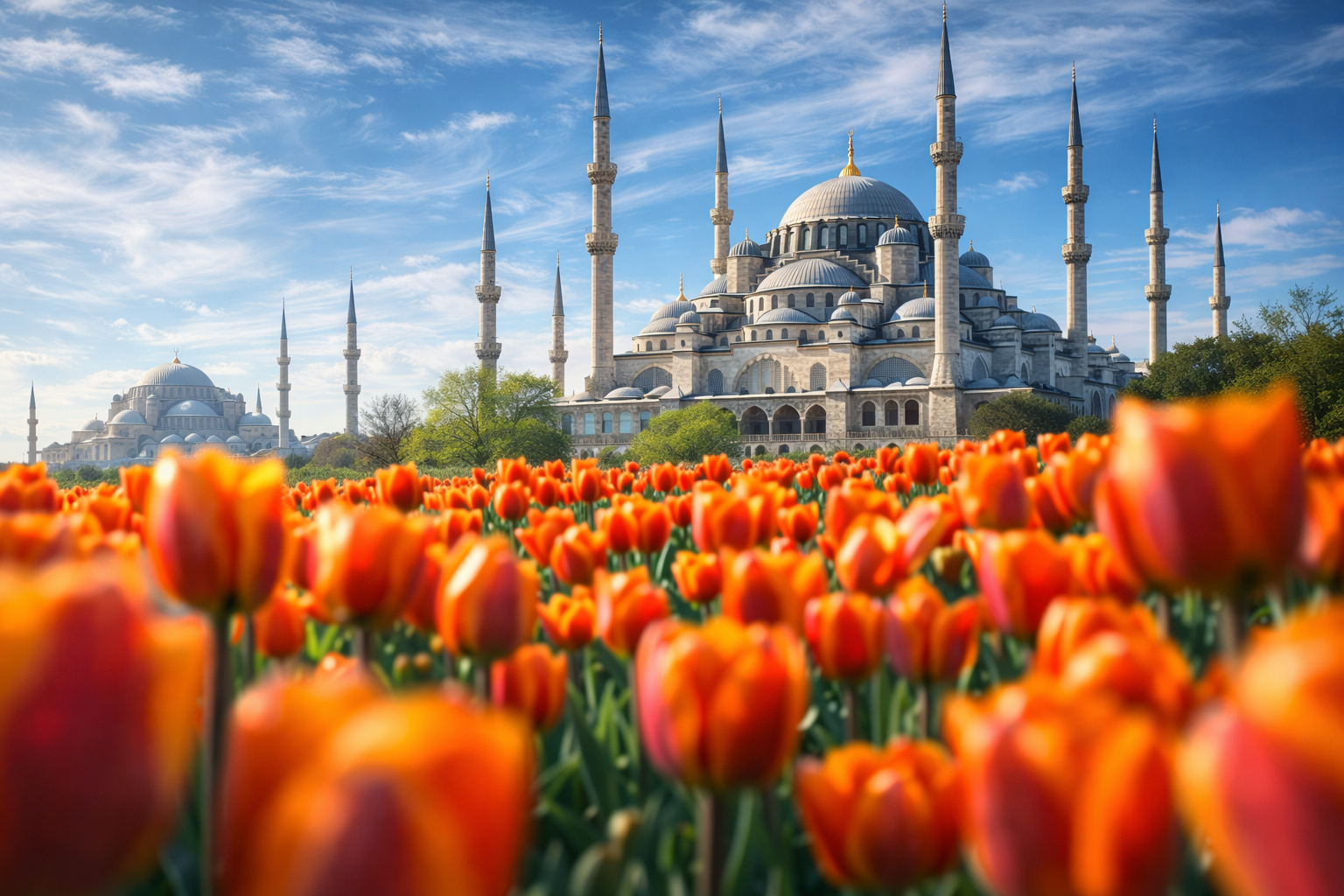
Istanbul is the only city in the world that spans two continents at once: its European and Asian sides are separated by the Bosporus Strait. But that’s not the only thing drawing travelers here. In spring, there’s another reason to visit: millions of tulips transform the streets, parks, and squares into a vibrant carpet of color.
Every year from March to May, the city bursts into bloom with dozens of varieties and shades. But for Turks, the tulip is much more than just a beautiful flowerbed. It carries deep symbolic meaning, closely associated with the golden age of the Ottoman Empire. It’s no coincidence that the traditional Turkish tea glass is shaped like a tulip — in Turkey, drinking tea isn’t just a habit, it’s a way of life.
So if you still think of tulips as something that primarily belongs to the Netherlands, Istanbul would disagree. The story of this flower is far older and far more fascinating — and it begins right here.
The flower that became a symbol of the Ottoman dynasty

In Turkey, tulips are much more than just beautiful flowers in a garden bed. They are a symbol with centuries of history, closely tied to one of the greatest empires in the world — the Ottoman Empire. Their story actually began far from Istanbul, in the Asian steppes, where tulips first grew as wild plants.
The Persians called the flower “laleh,” while the Turks adopted the word “lale.” It was in the Ottoman Empire that the tulip first moved from the wild into palace gardens. There, it quickly became more than just a decorative plant — it turned into a symbol of power and status. Wearing jewelry decorated with tulip motifs was permitted only for the sultan and members of his family.
The peak of the empire’s prosperity in the 18th century even came to be known as the Tulip Era. During that time, thousands of tulip varieties were cultivated, magnificent garden celebrations were held, and the tulip firmly established itself as a symbol of the ruling dynasty.
In the 16th century, the flower was brought from the Ottoman Empire to the Netherlands, where it caused a sensation. Prices for tulip bulbs soared to incredible heights, and speculation soon followed. That’s how the world eventually came to associate the tulip with Holland. Yet in Istanbul, people know perfectly well where the story of the tulip truly began.
The festival today: impressive numbers

Every year, between 25 and 30 million tulips are planted across Istanbul. The flowers appear in more than 800 locations throughout the city — in parks, squares, road interchanges, along the waterfront, and even on central plazas near mosques and palaces.
It is considered the largest urban flower festival in the world, and the best part is that it takes place entirely outdoors — with no tickets and no fixed schedule.
The question “When do tulips bloom in Turkey?” attracts thousands of tourists every year. The tulip season in Turkey officially begins in March and lasts until the end of May. However, the peak of the bloom comes in April. That’s when early, mid-season, and late varieties all flower at the same time, making the city look especially spectacular.
The exact timing depends on the weather: a warm winter can bring the bloom earlier, while a colder one may delay it by a week or two. If you’re planning a trip specifically to see the tulips, aim for the first half of April — this is when Istanbul truly turns into a living postcard.
Because the blooming period changes slightly each year, local flower enthusiasts start watching weather forecasts as early as February, trying to predict when the tulips will reach their most beautiful moment.
The Istanbul International Tulip Festival doesn’t have a single central stage — it’s more like the entire city becomes the festival, stretching across both sides of the Bosporus.
The main events take place in Emirgan Park on the European side, Gülhane Park near the Topkapi Palace, and Sultanahmet Square. But tulips can be found literally around every corner — even in ordinary residential neighborhoods, where flowerbeds are tended with special care.
Here’s why: every autumn, the city government gives away tulip bulbs for free to residents so that everyone can decorate their yards, balconies, or entrances. This way, the festival extends far beyond the official parks and truly becomes a people’s festival. The city blooms not only where it’s planned, but also where people live.
Entry to all festival locations is free.It’s probably the only festival of this scale in the world where you don’t need a ticket — just show up and enjoy the colors.
The best festival spots

The Istanbul Tulip Festival isn’t confined to a single location — the entire city transforms into a floral route. Here are the main spots you won’t want to miss.

Emirgan Park — the undisputed star of the festival. This park hosts the largest collection of tulip varieties, with carefully tended flowerbeds interspersed with gazebos and stunning views of the Bosporus. In April, the park is open from early morning until late evening, and even on weekdays it can get busy. Arrive by 9 a.m. to enjoy a few quiet hours before the crowds.
How to get there: From Sultanahmet Station, take tram T1 to Kabataş, then a 3-minute walk to the bus terminal and catch bus 25E to Emirgan. From Taksim Square, buses 40T or 42T go directly to Emirgan.

Gülhane Park is located right next to the walls of Topkapi Palace, which makes it truly special. Tulips here grow against the backdrop of Ottoman architecture, creating postcard-perfect views at every turn. The tulip season feels especially magical here — it’s easy to imagine that these flowers bloomed in the same spot back in the days of the sultans — and, in fact, they did.

Sultanahmet Square — the heart of the old city — features tulip beds planted between the Blue Mosque and Hagia Sophia. The photos here are stunning, but be prepared for crowds: it’s always busy.
Belgrad Forest, north of the city, is perfect for those looking to escape the central hustle and bustle. While it doesn’t have huge flowerbeds, it offers a more natural, peaceful atmosphere — ideal for a walk with children or a picnic surrounded by greenery and blooms.
How to get there: Take bus 42T from Taksim Square to the final stop, Belgrad Ormanı, then walk into the forest.
And don’t limit yourself to Istanbul! Tulip fields can also be seen outside the city: in the provinces of Izmir and Afyonkarahisar, tulips are grown commercially. During the tulip season, these fields can rival the famous Keukenhof in the Netherlands — but without the lines, and with Turkish tea waiting at a nearby café.
How to plan your trip: practical tips

Seeing tulips in Turkey is a spectacle that doesn’t forgive poor planning. Arrive a week too late, and all you’ll see are green stems. Show up at a park on a weekend afternoon, and you might not get a single decent photo because of the crowds. A few simple tips can help you avoid this.
1. Watch the timing in advance. There’s no single answer to the question “When do tulips bloom in Turkey?” — it all depends on the winter. A good rule of thumb is the first or second week of April, though in a warm winter, the bloom can start as early as March. Follow Istanbul parks or tourism pages on social media — they often post up-to-date photos even before the season begins.
2. Plan for an early start. Parks open around 7–8 a.m., and by 10 a.m. on weekdays, they’re already getting busy. Early morning gives you golden light, peaceful surroundings, and the chance to stroll among the flowerbeds undisturbed — all of which disappear once the first tourist buses arrive.
3. Choose weekdays. On weekends, Emirgan Park turns into a bustling fair — families with children, tour groups, and corn vendors everywhere. If possible, visit on a Monday or Tuesday for a calmer experience.
4. Carry small cash. Entrance to the parks is free, but tea, snacks, and souvenirs sold near the gates are cash-only. Enjoying a cup of traditional Istanbul tea among the tulips is an experience you definitely shouldn’t skip.
5. Allow extra days. If you’re traveling specifically for the festival, plan to stay at least 4–5 days in the city. This gives you enough time to explore the parks, see the rest of Istanbul, and have a backup day in case of rain or cloudy skies.
Istanbul in Spring: More Than Just Flowers

Spring in Turkey isn’t just about tulips. April and May are considered the most comfortable months for visiting Istanbul: temperatures usually stay around 15–20°C (59–68°F), there’s little rain, and the summer crowds haven’t arrived yet. The city moves at its normal pace — giving you a chance to see it the way locals do.
While tulips bloom in the parks, the markets start offering the first strawberries and cherries of the season. The Grand Bazaar and the Spice Bazaar are especially pleasant in spring — without the scorching summer heat, vendors aren’t in a rush, and even bargaining feels calmer. Spring is the perfect time to hunt for ceramics, spices, and authentic Turkish delight.
The Bosphorus is another reason to go for a walk in spring. The ferry crossing between the European and Asian sides is affordable and offers some of the best views of the city. In April, the water is calm, the sky is clear, and the skyline of mosque domes looks especially sharp.
The Princes’ Islands are another often-overlooked spring destination. A ferry from Kabataş takes you to Büyükada in about an hour. There are no cars, only bicycles, quiet streets, and blooming gardens — an ideal day to relax and escape the city’s pace.

And finally — food. In spring, Istanbul’s restaurants and street cafés move their tables outdoors, turning dinner with a view of the Bosphorus or by the foot of an old fortress into a completely different experience than at any other time of year. Order mezze, fresh fish, and don’t forget Turkish tea served in the traditional tulip-shaped glasses. This isn’t a coincidence — the glass itself is named after the flower.
Tulips bloom for a short time — two, at most three weeks at their peak. And it’s precisely this fleeting beauty that makes the festival so special. You can’t pause it, postpone it, or watch it later on a screen. You’re either here — or you wait until next year.
Istanbul knows how to leave you wanting more. Istanbul has a way of giving just enough to make you crave more. There’s always another neighborhood you haven’t explored, another viewpoint not mentioned in any guidebook, another flavor that’s hard to describe. In spring, tulips are added to the list — and the city becomes an even better version of itself.
So, if you haven’t been yet, this is your reason to plan a trip. And if you have, you already know exactly what we mean.
Start your journey with some smart shopping at a duty-free store at the border. To make sure you don’t forget anything and can buy everything without the rush, plan your purchases in advance: select your items on the website or in the MyDutyFree app. Simply:
1. Choose the location where you’ll cross the border.
2. Browse the online duty-free catalog for that location.
3. Indicate your date and approximate crossing time.
4. Place your pre-order with a 5% discount.
5. Your pre-ordered items will be ready at the duty-free checkout, so you can pay on the spot without wasting time — quick, easy, and stress-free.
Locations where the service operates
1. Ukrainian bordershops
At the Ukrainian border, the service is available at the following checkpoints:
- With Romania: Porubne, Dyakovo, Solotvyno
- With Hungary: Chop Tisa, Luzhanka, Kosyno, Vylok
- With Slovakia: Uzhhorod, Malyi Bereznyi
- With Poland: Yahodyn
2. Georgian bordershops
When crossing the Georgian border by land with Armenia, Turkey, or Azerbaijan, pre-selection is available at the following checkpoints:
4. Armenian border shop
At the Georgia–Armenia border:
4. Airports